 In Part 1 I listed some events that closely preceded Yeshua’s Cleansing of the Temple. Now here’s my take-away from all that was listed.
- The fact that Passover was approaching meant that all Jews were cleansing their homes of leaven (symbolic of sin) in obedience to the Torah. They were diligently sweeping out of their houses even the crumbs of anything containing leaven. And need we say it? Yeshua was not only a Jew, obedient to the spirit of Torah – but He was the living embodiment of Torah. [John 1:16 – “The Word became flesh and tabernacled among us.”]
- Yeshua foresaw and had prepared His close disciples for His imminent crucifixion. He may even have paid a parting visit to his mother and siblings (if John 2:12 applies to this Passover period). He had announced the prophetic significance of Miriam anointing Him with the very costly oil of spikenard, saying it was for His burial. The time for His sacrificial death as the final Passover Lamb was at hand and He knew it, so Yeshua was absolutely ready for the worst that His opponents could do to Him.
- Knowing what was ahead and how prophecies had to be fulfilled in the final Jerusalem visit of His first advent, Yeshua realized He would have to go it alone for some parts of His journey to ‘the tree’ (the cross). I believe His ‘going ahead’ of the disciples was the beginning of this. In addition, the Triumphal Entry was to confirm His Messianic identity to the already suspecting or converted crowds, and their general response to Him was actually worship and a plea for salvation. No one else could rightly have been on the receiving end of that, or of what would follow. So Yeshua went ahead of the disciples because He was the only One due to receive all that adulation, and also to spare them from being complicit in some of the actions He was about to take, and from being subject to the consequences.
- Despite His knowledge that the time of His crucifixion was near, Yeshua was absolutely confident of His pivotal role in that moment of history, and His dominion over the earth – hence His retort to the Pharisees’ attempted censorship, that the very rocks around them would automatically cry out if the people (who had free will) didn’t. As always, Yeshua was unafraid of the Pharisees, and this time He was setting the stage for a final showdown.
- Yeshua was also emotional at this time, just as He had been at His recent visit to Lazarus’ tomb with the mourning family (John 11: 33-35). Then He had wept with those who mourned. This time He was weeping over Jerusalem, Zion, the City of God, which had failed to see “the things that lead to shalom” and to “recognize the time of (their) visitation.” Jerusalem was therefore doomed to destruction by their enemies, and Yeshua wept with the weight of this knowledge. Besides, in-between these two weeping episodes He had been forced into hiding, as the Sanhedrin was plotting to kill him (prematurely) due to the evangelistic effect of His having raised Lazarus from the dead (John 12:9-10). All told, I would say this was not the most “cool as a cucumber” period of Yeshua’s life.
- Yet He navigated through the stirred-up throngs of people to reach the Temple and spent some time “looking around at everything” (Mark 11:11) before returning to Bethany with his disciples for the night. In the morning, on His trek back to Jerusalem with disciples, a hungry Yeshua began to display some vaguely uncharacteristic behaviour. In previous Gospel chapters He had been teaching and demonstrating how to bless… bless even your enemies, even those who curse and abuse you… and how to steward even the inanimate provisions of God (for example by having the 12 baskets full of leftovers collected after multiplying food and feeding a multitude.) On this particular morning though, Yeshua gave the disciples a lesson on when and how to curse, and which things should not be conserved – the fig tree that refused support to the Messiah being the teaching aid. Yeshua said to the tree, “May no one ever eat fruit from you again!” (Mark 11:13). Verse 14 makes the point, “And His disciples were listening.” Listening wide-eyed I guess, and wondering, “What’s up with Him today?”
Finally the stage was set for Yeshua to take His stand as Master of His and His Father’s house which He had inspected the evening before… the Temple. John gives the most graphic and detailed account of what happened when Yeshua got there. John 2:14-17 says:
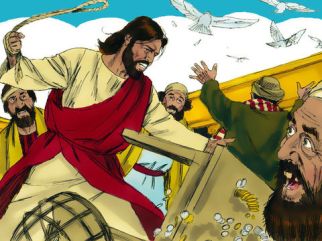
“In the Temple, He found the merchants selling oxen, sheep, and doves; also the money-changers sitting there. Then He made a whip of cords and drove them all out of the Temple, both the sheep and oxen. He dumped out the coins of the money-changers and overturned their tables. To those selling doves, He said, ‘Get these things out of here! Stop making My Father’s house a marketplace!’ His disciples remembered that it is written, ‘Zeal for Your House will consume Me!'” (Psalm 69:10)
Wow! Yeshua deliberately made a whip of cords (no accidental pop-up of a whip in His hand), and with it He actually drove out the merchants’ stock of sacrificial animals (according to John) as well as the merchants (according to Luke) and even their patrons (according to Matthew and Mark). They were all chased out by Yeshua. In the process, for good measure and to ensure they knew He was resolute, He even turned over the tables of the money-changers (cambio operators?) and the seats of the dove-sellers, saying (calmly, in moderate tones … “Please, kindly take your operations outside, if you don’t mind”)?
No, God forbid we should try to soft-soap Yeshua’s obvious ire. He was living in a human body, and had normal adrenaline, elevated to fight-mode, not flight-mode. He was at the stage of His earthly ministry where He had nothing to lose from shocking or upsetting the chief priests and so-called Torah scholars. I’m willing to bet He raised His voice to ensure that both man and beast heard His command, “Get these things out of here! Stop making My Father’s house a marketplace!”
When I get to heaven I’ll ask if I was wrong, but for now, just let’s just ponder Yeshua’s words and actions some more, in Part 3.

