Matthew, Mark and Luke record these words that Yeshua spoke to the merchants as He cleansed the Temple, which should have reminded them of a prophecy from Isaiah: “My house shall be called a house of prayer (Is. 56:7), but you have made it a den of thieves.” Some of the merchants may also have matched Yeshua’s last words to those of the similarly grieved prophet Jeremiah, who had much earlier spoken for the LORD saying, “Has this House, which bears My Name, become a den of robbers in your eyes? Look, even I have seen it!” (Jer. 7:11)
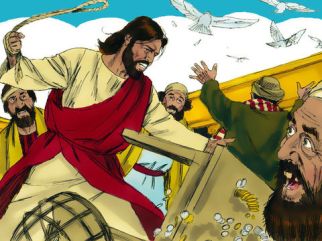
The whip-wielding, irate, disruptive Person who cleansed the Temple was certainly not ‘gentle Jesus meek and mild’! But He was the same One Who said in Matthew 10:34-36, “Do not think that I came to bring shalom on the earth; I did not come to bring shalom, but a sword. For I have come to set (even, as written in Micah 7:6) ‘a man against his father, a daughter against her mother, and a daughter-in-law against her mother-in-law; and a man’s enemies will be the members of his household.’”
His was the same Spirit Who had earlier inspired King Solomon to write in Ecclesiastes 3:1-8, “For everything there is a season and a time for every activity under heaven: a time to give birth and a time to die, time to plant and a time to uproot what is planted; a time to kill and a time to heal, a time to tear down and a time to build up; a time to weep and a time to laugh, a time to mourn and a time to dance; a time to scatter stones and a time to gather stones, a time to embrace and a time to refrain from embracing; a time to seek and a time to lose, a time to keep and a time to discard; a time to tear apart and a time to mend, a time to be silent and a time to speak; a time to love and a time to hate, a time for war and a time for peace.”
His was the same Spirit who would later inspire an apostle to the dispersed Jews to assert, “The word of God is living and active and sharper than any two-edged sword—piercing right through to a separation of soul and spirit, joints and marrow, and able to judge the thoughts and intentions of the heart.” (Hebrews 4:12)
Lest I digress further, let’s return to Mark’s account of The Cleansing of the Temple. Mark was the only Gospel writer who fully quoted the last part of Isaiah 56:7, which actually says, “My House will be called a House of Prayer for all nations.” The Temple at that time (the ‘Second Temple’ refurbished by Herod the Great) was divided into different sections – for the priests, for Jews and for Gentiles. Gentiles (non-Jews) were only permitted to congregate in the Court of the Gentiles. They had no access to the rest of the Temple area. However, the Jews had free access to the Court of the Gentiles, so it became a popular place for mixed public gatherings. This is where the buyers and sellers were conducting their business, so far frustrating the divine purpose for the area. When we look at more of the prophecy in Isaiah 56:6-7, we see God’s will for the entire Temple.
“Also the foreigners who join themselves to Adonai, to minister to Him, and to love the Name of Adonai, and to be His servants— all who keep from profaning Shabbat, and hold fast to My covenant— these I will bring to My holy mountain, and let them rejoice in My House of Prayer. Their burnt offerings and sacrifices will be acceptable on My altar. For My House will be called a House of Prayer for all nations.”
God’s intention was that both Jews and Gentiles should find, in the Temple, a House of Prayer. The commercialization of the Court of the Gentiles had hindered that. Furthermore, it is likely that this area was where Yeshua targeted His teaching, for it was bordered by a raised, covered pavilion that would have afforded Him the best vantage point. Against all of that background, we can better understand His ire at the subversion of the divine purpose for the Temple.
Two things stood out to me in my updated research on ‘The Cleansing of the Temple’, which amplified my appreciation of the righteous indignation that Yeshua displayed. The first was the fact that, like all Jews preparing for Passover, He had to ‘clean house’ – getting rid of all ‘leaven’, symbolic of sin. While his mother Miriam would have been cleaning the house of her family, Yeshua had to clean the House of His Father! There was no other Son who could do that. The zeal with which observant Jews approached their sweeping of leaven from their houses was amplified in Yeshua’s heart as He approached the cleansing of His Father’s House – the most important ‘house’ that so far existed. Secondly, I was impressed by the understanding that the Court of the Gentiles was the site of this cleansing, and that Yeshua was zealous about the Gentiles having equal opportunity to the blessings of His Father’s House of Prayer, as the Father intended. As a Gentile, I was very touched by that.
Yet, the Ruach (Spirit) impressed on me that the most critical aspect to consider is this. If Yeshua was so zealous over the cleansing of God’s ancient physical Temple, and so righteously indignant against the abuse of it, how much more must He, and should we, now be zealous over the cleansing of God’s current Temple – His people – and righteously indignant over whatever the devil uses to try and pollute them! 1 Corinthians 3:16-17 says, “Don’t you know that you are God’s temple and that the Ruach Elohim (Spirit of God) dwells among you? If anyone destroys God’s temple, God will destroy him; for God’s temple is holy, and you are that temple.” Collectively we believers are His Temple, and also individually, as made clear by 1 Corinthians 6:19-20, which says, “Don’t you know that your body is a temple of the Ruach ha-Kodesh who is in you, whom you have from God and that you are not your own? For you were bought with a price.”
Bought with a price – the precious blood that Yeshua was preparing to shed as the final sacrificial Passover Lamb for us, even as He chased the sacrificial animals and their buyers and sellers out of the Temple with His whip. We need to be every bit as zealous over God’s current Temple as Yeshua demonstrated He was over that ancient one. It’s time for us to stop playing ‘Mr. Nice Guy’ with agents of evil, but rather, chase them out of our lives and thereby out of the Body of Messiah. I could go on and on, (for example with Yeshua’s teaching at Matthew 5:29-30 and Paul’s at Galatians 5:9) but I’ll stop now.
May the Lord add to your own thoughts and meditation on these matters. Selah!
 In Part 1 I listed some events that closely preceded Yeshua’s Cleansing of the Temple. Now here’s my take-away from all that was listed.
 evangelineworks