The Cleansing of the Temple, Conclusion

Matthew, Mark and Luke record these words that Yeshua spoke to the merchants as He cleansed the Temple, which should have reminded them of a prophecy from Isaiah: “My house shall be called a house of prayer (Is. 56:7), but you have made it a den of thieves.” Some of the merchants may also have matched Yeshua’s last words to those of the similarly grieved prophet Jeremiah, who had much earlier spoken for the LORD saying, “Has this House, which bears My Name, become a den of robbers in your eyes? Look, even I have seen it!” (Jer. 7:11)

The whip-wielding, irate, disruptive Person who cleansed the Temple was certainly not ‘gentle Jesus meek and mild’!  But He was the same One Who said in Matthew 10:34-36, “Do not think that I came to bring shalom on the earth; I did not come to bring shalom, but a sword. For I have come to set (even, as written in Micah 7:6) ‘a man against his father, a daughter against her mother, and a daughter-in-law against her mother-in-law; and a man’s enemies will be the members of his household.’”

His was the same Spirit Who had earlier inspired King Solomon to write in Ecclesiastes 3:1-8, “For everything there is a season and a time for every activity under heaven: a time to give birth and a time to die, time to plant and a time to uproot what is planted; a time to kill and a time to heal, a time to tear down and a time to build up; a time to weep and a time to laugh, a time to mourn and a time to dance; a time to scatter stones and a time to gather stones, a time to embrace and a time to refrain from embracing; a time to seek and a time to lose, a time to keep and a time to discard; a time to tear apart and a time to mend, a time to be silent and a time to speak; a time to love and a time to hate, a time for war and a time for peace.”

His was the same Spirit who would later inspire an apostle to the dispersed Jews to assert, “The word of God is living and active and sharper than any two-edged sword—piercing right through to a separation of soul and spirit, joints and marrow, and able to judge the thoughts and intentions of the heart.” (Hebrews 4:12)

Lest I digress further, let’s return to Mark’s account of The Cleansing of the Temple. Mark was the only Gospel writer who fully quoted the last part of Isaiah 56:7, which actually says, “My House will be called a House of Prayer for all nations.” The Temple at that time (the ‘Second Temple’ refurbished by Herod the Great) was divided into different sections – for the priests, for Jews and for Gentiles. Gentiles (non-Jews) were only permitted to congregate in the Court of the Gentiles. They had no access to the rest of the Temple area. However, the Jews had free access to the Court of the Gentiles, so it became a popular place for mixed public gatherings. This is where the buyers and sellers were conducting their business, so far frustrating the divine purpose for the area. When we look at more of the prophecy in Isaiah 56:6-7, we see God’s will for the entire Temple.

“Also the foreigners who join themselves to Adonai, to minister to Him, and to love the Name of Adonai, and to be His servants— all who keep from profaning Shabbat, and hold fast to My covenant— these I will bring to My holy mountain, and let them rejoice in My House of Prayer. Their burnt offerings and sacrifices will be acceptable on My altar. For My House will be called a House of Prayer for all nations.”

God’s intention was that both Jews and Gentiles should find, in the Temple, a House of Prayer. The commercialization of the Court of the Gentiles had hindered that. Furthermore, it is likely that this area was where Yeshua targeted His teaching, for it was bordered by a raised, covered pavilion that would have afforded Him the best vantage point. Against all of that background, we can better understand His ire at the subversion of the divine purpose for the Temple.

Two things stood out to me in my updated research on ‘The Cleansing of the Temple’, which amplified my appreciation of the righteous indignation that Yeshua displayed.  The first was the fact that, like all Jews preparing for Passover, He had to ‘clean house’ – getting rid of all ‘leaven’, symbolic of sin. While his mother Miriam would have been cleaning the house of her family, Yeshua had to clean the House of His Father! There was no other Son who could do that. The zeal with which observant Jews approached their sweeping of leaven from their houses was amplified in Yeshua’s heart as He approached the cleansing of His Father’s House – the most important ‘house’ that so far existed.  Secondly, I was impressed by the understanding that the Court of the Gentiles was the site of this cleansing, and that Yeshua was zealous about the Gentiles having equal opportunity to the blessings of His Father’s House of Prayer, as the Father intended. As a Gentile, I was very touched by that.

Yet, the Ruach (Spirit) impressed on me that the most critical aspect to consider is this. If Yeshua was so zealous over the cleansing of God’s ancient physical Temple, and so righteously indignant against the abuse of it, how much more must He, and should we, now be zealous over the cleansing of God’s current Temple – His people – and righteously indignant over whatever the devil uses to try and pollute them!  1 Corinthians 3:16-17 says, “Don’t you know that you are God’s temple and that the Ruach Elohim (Spirit of God) dwells among you?  If anyone destroys God’s temple, God will destroy him; for God’s temple is holy, and you are that temple.” Collectively we believers are His Temple, and also individually, as made clear by 1 Corinthians 6:19-20, which says, “Don’t you know that your body is a temple of the Ruach ha-Kodesh who is in you, whom you have from God and that you are not your own? For you were bought with a price.”

Bought with a price – the precious blood that Yeshua was preparing to shed as the final sacrificial Passover Lamb for us, even as He chased the sacrificial animals and their buyers and sellers out of the Temple with His whip. We need to be every bit as zealous over God’s current Temple as Yeshua demonstrated He was over that ancient one.  It’s time for us to stop playing ‘Mr. Nice Guy’ with agents of evil, but rather, chase them out of our lives and thereby out of the Body of Messiah. I could go on and on, (for example with Yeshua’s teaching at Matthew 5:29-30 and Paul’s at Galatians 5:9) but I’ll stop now.

May the Lord add to your own thoughts and meditation on these matters. Selah!
The Cleansing of the Temple, Part 2

003-jesus-cleansing-templeIn Part 1 I listed some events that closely preceded Yeshua’s Cleansing of the Temple. Now here’s my take-away from all that was listed.

  1. The fact that Passover was approaching meant that all Jews were cleansing their homes of leaven (symbolic of sin) in obedience to the Torah. They were diligently sweeping out of their houses even the crumbs of anything containing leaven. And need we say it? Yeshua was not only a Jew, obedient to the spirit of Torah – but He was the living embodiment of Torah. [John 1:16 – “The Word became flesh and tabernacled among us.”]
  2. Yeshua foresaw and had prepared His close disciples for His imminent crucifixion. He may even have paid a parting visit to his mother and siblings (if John 2:12 applies to this Passover period). He had announced the prophetic significance of Miriam anointing Him with the very costly oil of spikenard, saying it was for His burial. The time for His sacrificial death as the final Passover Lamb was at hand and He knew it, so Yeshua was absolutely ready for the worst that His opponents could do to Him.
  3. Knowing what was ahead and how prophecies had to be fulfilled in the final Jerusalem visit of His first advent, Yeshua realized He would have to go it alone for some parts of His journey to ‘the tree’ (the cross). I believe His ‘going ahead’ of the disciples was the beginning of this. In addition, the Triumphal Entry was to confirm His Messianic identity to the already suspecting or converted crowds, and their general response to Him was actually worship and a plea for salvation. No one else could rightly have been on the receiving end of that, or of what would follow. So Yeshua went ahead of the disciples because He was the only One due to receive all that adulation, and also to spare them from being complicit in some of the actions He was about to take, and from being subject to the consequences.
  4. Despite His knowledge that the time of His crucifixion was near, Yeshua was absolutely confident of His pivotal role in that moment of history, and His dominion over the earth – hence His retort to the Pharisees’ attempted censorship, that the very rocks around them would automatically cry out if the people (who had free will) didn’t. As always, Yeshua was unafraid of the Pharisees, and this time He was setting the stage for a final showdown.
  5. Yeshua was also emotional at this time, just as He had been at His recent visit to Lazarus’ tomb with the mourning family (John 11: 33-35). Then He had wept with those who mourned. This time He was weeping over Jerusalem, Zion, the City of God, which had failed to see “the things that lead to shalom” and to “recognize the time of (their) visitation.” Jerusalem was therefore doomed to destruction by their enemies, and Yeshua wept with the weight of this knowledge. Besides, in-between these two weeping episodes He had been forced into hiding, as the Sanhedrin was plotting to kill him (prematurely) due to the evangelistic effect of His having raised Lazarus from the dead (John 12:9-10). All told, I would say this was not the most “cool as a cucumber” period of Yeshua’s life.
  6. Yet He navigated through the stirred-up throngs of people to reach the Temple and spent some time “looking around at everything” (Mark 11:11) before returning to Bethany with his disciples for the night. In the morning, on His trek back to Jerusalem with disciples, a hungry Yeshua began to display some vaguely uncharacteristic behaviour. In previous Gospel chapters He had been teaching and demonstrating how to bless… bless even your enemies, even those who curse and abuse you… and how to steward even the inanimate provisions of God (for example by having the 12 baskets full of leftovers collected after multiplying food and feeding a multitude.) On this particular morning though, Yeshua gave the disciples a lesson on when and how to curse, and which things should not be conserved – the fig tree that refused support to the Messiah being the teaching aid. Yeshua said to the tree, “May no one ever eat fruit from you again!” (Mark 11:13). Verse 14 makes the point, “And His disciples were listening.” Listening wide-eyed I guess, and wondering, “What’s up with Him today?”

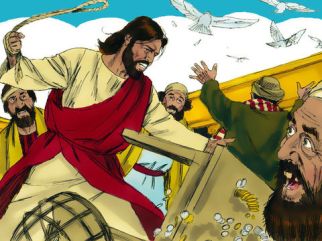
Finally the stage was set for Yeshua to take His stand as Master of His and His Father’s house which He had inspected the evening before… the Temple. John gives the most graphic and detailed account of what happened when Yeshua got there. John 2:14-17 says:

“In the Temple, He found the merchants selling oxen, sheep, and doves; also the money-changers sitting there. Then He made a whip of cords and drove them all out of the Temple, both the sheep and oxen. He dumped out the coins of the money-changers and overturned their tables. To those selling doves, He said, ‘Get these things out of here! Stop making My Father’s house a marketplace!’  His disciples remembered that it is written, ‘Zeal for Your House will consume Me!'” (Psalm 69:10)

Wow!  Yeshua deliberately made a whip of cords (no accidental pop-up of a whip in His hand), and with it He actually drove out the merchants’ stock of sacrificial animals (according to John) as well as the merchants (according to Luke) and even their patrons (according to Matthew and Mark).  They were all chased out by Yeshua. In the process, for good measure and to ensure they knew He was resolute, He even turned over the tables of the money-changers (cambio operators?) and the seats of the dove-sellers, saying (calmly, in moderate tones … “Please, kindly take your operations outside, if you don’t mind”)?

No, God forbid we should try to soft-soap Yeshua’s obvious ire. He was living in a human body, and had normal adrenaline, elevated to fight-mode, not flight-mode. He was at the stage of His earthly ministry where He had nothing to lose from shocking or upsetting the chief priests and so-called Torah scholars.  I’m willing to bet He raised His voice to ensure that both man and beast heard His command, “Get these things out of here! Stop making My Father’s house a marketplace!”

When I get to heaven I’ll ask if I was wrong, but for now, just let’s just ponder Yeshua’s words and actions some more, in Part 3.


The Cleansing of the Temple, Part 1

003-jesus-cleansing-templeOne incident in the life of Yeshua (‘Jesus’) that is related in all four Gospels is called ‘The Cleansing (or Purging) of the Temple’. Accounts are found in Matthew 21, Mark 11, Luke 19 and John 2. However, some of the circumstances surrounding the incident are found in other chapters. From the Synoptic Gospels it would seem to have been a unique event, but from John’s Gospel some scholars believe it may have happened more than once, because another Passover time is related from John 12 through 17. In light of this uncertainty, references from both John 2 and the later chapters are included below for our consideration.

I find The Cleansing of the Temple to be a very interesting event, as it shows one side of Yeshua’s ministry that is less fondly regarded than the healings of individual bodies and minds, or the feeding and preaching to crowds, or the discipleship ministry to His twelve apostles-in-training. In fact, it may be even less favourably regarded than Yeshua’s calling out of the Pharisees on their various sins. Here is what the Gospels tell us about the context of the event.

  • The annual Passover was approaching – Matt. 26:2; Mark 14:1; Luke 22:1; John 2:13, 12:1,12.
  • Yeshua had just spent some family time with His natural family – John 2:12.
  • He had just warned ‘the Twelve’ (His inner-circle disciples) of His impending crucifixion – Matt. 20:17-19; Mark 10:32-34; Luke 18:31-33.
  • He had just visited Miriam, Martha and Lazarus in Bethany, and been anointed with expensive oil of spikenard, prophetically (as He revealed) for His burial – John  12:1-8.
  • He and His disciples were going together up to Jerusalem for Passover, but at a certain point He was going ahead of the others – Mark 10:32, Luke 19:28.
  • He had also just sent two disciples to secure a chosen colt, for His entry into Jerusalem in the manner prophesied at Zechariah 9:9 – Matt. 21:1-7, Mark 11:1-7, Luke 19:29-35.
  • The ‘Triumphal Entry’ had just taken place, with Yeshua approaching Jerusalem on the donkey, crowds along the road spreading their clothes and freshly cut branches on the ground before Him, forerunners in front and a train of people behind Him shouting “Hoshia-na! (Lord, save!) Baruch ha-ba b’shem Adonai! (Blessed is He who comes in the name of the Lord!) The King of Israel!” – John 12:12-13. Slightly different versions are at Matt. 21:8-9 (calling Him ‘Ben David’ – son of David), Mark 11:8-10 (blessing ‘the coming kingdom of our father David’), and Luke 19:36-38 (hailing ‘the King who comes in the Name of Adonai’). Some of this was prophesied by King David at Psalm 118:25-26.
  • When the Pharisees objected to the crowds’ ascribing Him these Messianic titles, Yeshua had boldly said, “I tell you that if these (people) keep silent, the stones will shout out!” – Luke 19:40.
  • On seeing Jerusalem, He had paused to weep over the city and the future its inhabitants had sealed for themselves – Luke 19:41-44.
  • Following the Triumphal Entry, the whole city was stirred up, alerted to the arrival of “Yeshua from Natzeret in the Galilee”, who had raised Lazarus from the dead – Matt. 21:10, John 12:17-18.
  • Yeshua had first gone and looked through the Temple (late in the evening) before retiring to Bethany for the night with his disciples – Mark 11:11.
  • The next morning, enroute back to Jerusalem and hungry, He had approached a fig tree but found no fruit on it, and cursed it aloud in the hearing of His disciples.

What can we make of all this, and of what followed? See Part 2 for what it all says to me.


No one can stop the LORD Almighty!

IMG-20190618-WA0002

I am monocular, for all practical purposes blind in the left eye. So my right eye is even more precious to me than yours may be to you if you have the use of both eyes. And since I’m using this right eye to serve the LORD, it’s probably quite precious to Him too.

God had a plan for me to travel abroad on June 18 to begin a 2-month-long period of intense ministry to a very important person. Therefore, the devil made a plan to try and thwart God’s plan.

On the afternoon of June 17 I was completing final errands in preparation for my trip. At what should have been the last stop of the evening, I stepped up to the curb in front of a business place, and tripped. Down I went, unable to break the fall enough to avoid toppling over onto the right side of my face!

A wonderful patron in the store saw what had happened and rushed out to help me as I scrambled to my feet. Examining myself, I could hardly believe how little damage had been done. I only had a slightly sore right palm, from the hand having instinctively tried to break the fall, a slightly sore right knee, a bump above my right eyebrow and a bruise at the cheekbone of the eye socket.

The devil’s plan to injure me enough to thwart God’s plan for my departure the next day had failed!  The bruises and the bump and the soreness faded away quickly, while the pursuit of my assignment remained paramount. Only one faint ‘scar’ did God leave there to tell the tale.

20190803_110902

Have a look at my glasses, which were quite unscathed before the incident. Do you notice the scratches on the right side by the arm and a little scratch on the lens? These relatively new glasses could actually have been ruined; and God knows that although I have a spare, I do prefer these for general wear. Since the ‘damage’ is only cosmetic and not obvious enough to be distracting, I decided to leave these glasses just like that for a while, till they become part of a much bigger testimony.

You know that song, “The Lion and the Lamb”?  Well, when the lyrics present the rhetorical question, “Who can stop the Lord Almighty?” I sing, “None can stop the Lord Almighty!”