The Sunrise, the Joy, the Source

“There was evening and there was morning—one day” (the first day. Gen. 1:5b).  “So long as the earth exists… day and night will not cease” (Gen. 8:22).   “Joy comes in the morning! “(Ps. 30:5b).

One of my daughters-in-law sent me some photos from the beautiful sunrise in their backyard. She captioned them, “Too pretty not to share.” The scenes immediately reminded me of the scriptures above (and more) so I chose these four pictures for a quick encouragement to whomever could be blessed by this visual from the Creator.

Remember, Psalm 30:5a says that weeping (/ sadness / darkness) may endure for a night (a set period of time). That’s a probability (it may happen from time to time); but the rest of the verse states a certainty for the people of God (“His faithful ones” – verse 5). The absolute certainty is that while the earth remains, morning is surely going to follow the night, and as the Scripture says, “Joy comes in the morning.

Whether your morning dawns here or in eternity, joy will come in the morning! Looking to the east (the direction from which the sun rises) to watch for its rising, is like looking to the Source of our joy for the timely bursting forth of His promises! Let’s fix our eyes on the Source of our joy; or, if He seems hidden by the darkness of night, let’s seek Him where He may be found (in His Scriptures, among His people, in the beauty of His creation), and watch for the sunrise (the ‘Son-rise’) that will surely come!

Hosea 6:3 says, “Let us strive to know Adonai (the LORD). Like dawn His going forth is certain. He will come to us…”

In these pictures the sun is rising over a snow-covered landscape, but if that illustration doesn’t impact you, imagine the one that faced Elijah in 1 Kings 17-18. Drought and famine… a drought that he had actually called for, in his authority as God’s fiery prophet in that time and place. (1 Kings 17:1, James 5:17)  This distress had lasted three and a half years when Elijah finally had a showdown with King Ahab and the prophets of Baal on Mount Carmel (1 Kings 18) which ended with all the survivors acknowledging “Adonai, He is God! Adonai, He is God!”

Now Elijah had to ‘look to the east’ (the Source), for the long ‘night’ of drought to be broken – broken not by a sunrise, but by a downpour of rain (as God had promised him – 1 Kings 18:1).  Let the Scripture minister directly to you from here on. It speaks for itself.
——————————-

41 Then Elijah said to Ahab, “Go up, eat and drink, for there’s the sound of rain.” (Prophetic sound, based on God’s promise.) 42 So Ahab went up to eat and drink. Elijah went up to the top of Carmel, crouched on the ground and put his face between his knees (praying). 43 Then he said to his servant, “Go up now, look toward the sea.”

So he went up, looked, and said, “There’s nothing.”

Then he said, “Go back”—seven times— (still praying) 44 and it was the seventh time that he said, “Look! A cloud as small as a man’s hand is rising from the sea.”

Then he said, “Go up, say to Ahab, ‘Harness your chariot and go down before the rain stops you.’”

45 In a little while the sky grew black with clouds and wind, and there was a heavy rain!
————————————-

Whether you’re looking for a sunrise to end a dark night, or a heavy rain to break a long drought, look to the Source!


The Cleansing of the Temple, Conclusion

Matthew, Mark and Luke record these words that Yeshua spoke to the merchants as He cleansed the Temple, which should have reminded them of a prophecy from Isaiah: “My house shall be called a house of prayer (Is. 56:7), but you have made it a den of thieves.” Some of the merchants may also have matched Yeshua’s last words to those of the similarly grieved prophet Jeremiah, who had much earlier spoken for the LORD saying, “Has this House, which bears My Name, become a den of robbers in your eyes? Look, even I have seen it!” (Jer. 7:11)

The whip-wielding, irate, disruptive Person who cleansed the Temple was certainly not ‘gentle Jesus meek and mild’!  But He was the same One Who said in Matthew 10:34-36, “Do not think that I came to bring shalom on the earth; I did not come to bring shalom, but a sword. For I have come to set (even, as written in Micah 7:6) ‘a man against his father, a daughter against her mother, and a daughter-in-law against her mother-in-law; and a man’s enemies will be the members of his household.’”

His was the same Spirit Who had earlier inspired King Solomon to write in Ecclesiastes 3:1-8, “For everything there is a season and a time for every activity under heaven: a time to give birth and a time to die, time to plant and a time to uproot what is planted; a time to kill and a time to heal, a time to tear down and a time to build up; a time to weep and a time to laugh, a time to mourn and a time to dance; a time to scatter stones and a time to gather stones, a time to embrace and a time to refrain from embracing; a time to seek and a time to lose, a time to keep and a time to discard; a time to tear apart and a time to mend, a time to be silent and a time to speak; a time to love and a time to hate, a time for war and a time for peace.”

His was the same Spirit who would later inspire an apostle to the dispersed Jews to assert, “The word of God is living and active and sharper than any two-edged sword—piercing right through to a separation of soul and spirit, joints and marrow, and able to judge the thoughts and intentions of the heart.” (Hebrews 4:12)

Lest I digress further, let’s return to Mark’s account of The Cleansing of the Temple. Mark was the only Gospel writer who fully quoted the last part of Isaiah 56:7, which actually says, “My House will be called a House of Prayer for all nations.” The Temple at that time (the ‘Second Temple’ refurbished by Herod the Great) was divided into different sections – for the priests, for Jews and for Gentiles. Gentiles (non-Jews) were only permitted to congregate in the Court of the Gentiles. They had no access to the rest of the Temple area. However, the Jews had free access to the Court of the Gentiles, so it became a popular place for mixed public gatherings. This is where the buyers and sellers were conducting their business, so far frustrating the divine purpose for the area. When we look at more of the prophecy in Isaiah 56:6-7, we see God’s will for the entire Temple.

“Also the foreigners who join themselves to Adonai, to minister to Him, and to love the Name of Adonai, and to be His servants— all who keep from profaning Shabbat, and hold fast to My covenant— these I will bring to My holy mountain, and let them rejoice in My House of Prayer. Their burnt offerings and sacrifices will be acceptable on My altar. For My House will be called a House of Prayer for all nations.”

God’s intention was that both Jews and Gentiles should find, in the Temple, a House of Prayer. The commercialization of the Court of the Gentiles had hindered that. Furthermore, it is likely that this area was where Yeshua targeted His teaching, for it was bordered by a raised, covered pavilion that would have afforded Him the best vantage point. Against all of that background, we can better understand His ire at the subversion of the divine purpose for the Temple.

Two things stood out to me in my updated research on ‘The Cleansing of the Temple’, which amplified my appreciation of the righteous indignation that Yeshua displayed.  The first was the fact that, like all Jews preparing for Passover, He had to ‘clean house’ – getting rid of all ‘leaven’, symbolic of sin. While his mother Miriam would have been cleaning the house of her family, Yeshua had to clean the House of His Father! There was no other Son who could do that. The zeal with which observant Jews approached their sweeping of leaven from their houses was amplified in Yeshua’s heart as He approached the cleansing of His Father’s House – the most important ‘house’ that so far existed.  Secondly, I was impressed by the understanding that the Court of the Gentiles was the site of this cleansing, and that Yeshua was zealous about the Gentiles having equal opportunity to the blessings of His Father’s House of Prayer, as the Father intended. As a Gentile, I was very touched by that.

Yet, the Ruach (Spirit) impressed on me that the most critical aspect to consider is this. If Yeshua was so zealous over the cleansing of God’s ancient physical Temple, and so righteously indignant against the abuse of it, how much more must He, and should we, now be zealous over the cleansing of God’s current Temple – His people – and righteously indignant over whatever the devil uses to try and pollute them!  1 Corinthians 3:16-17 says, “Don’t you know that you are God’s temple and that the Ruach Elohim (Spirit of God) dwells among you?  If anyone destroys God’s temple, God will destroy him; for God’s temple is holy, and you are that temple.” Collectively we believers are His Temple, and also individually, as made clear by 1 Corinthians 6:19-20, which says, “Don’t you know that your body is a temple of the Ruach ha-Kodesh who is in you, whom you have from God and that you are not your own? For you were bought with a price.”

Bought with a price – the precious blood that Yeshua was preparing to shed as the final sacrificial Passover Lamb for us, even as He chased the sacrificial animals and their buyers and sellers out of the Temple with His whip. We need to be every bit as zealous over God’s current Temple as Yeshua demonstrated He was over that ancient one.  It’s time for us to stop playing ‘Mr. Nice Guy’ with agents of evil, but rather, chase them out of our lives and thereby out of the Body of Messiah. I could go on and on, (for example with Yeshua’s teaching at Matthew 5:29-30 and Paul’s at Galatians 5:9) but I’ll stop now.

May the Lord add to your own thoughts and meditation on these matters. Selah!

The Cleansing of the Temple, Part 2

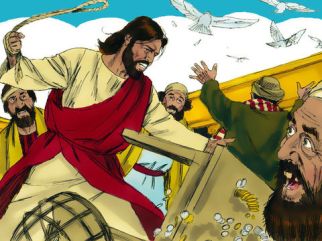
003-jesus-cleansing-templeIn Part 1 I listed some events that closely preceded Yeshua’s Cleansing of the Temple. Now here’s my take-away from all that was listed.

  1. The fact that Passover was approaching meant that all Jews were cleansing their homes of leaven (symbolic of sin) in obedience to the Torah. They were diligently sweeping out of their houses even the crumbs of anything containing leaven. And need we say it? Yeshua was not only a Jew, obedient to the spirit of Torah – but He was the living embodiment of Torah. [John 1:16 – “The Word became flesh and tabernacled among us.”]
  2. Yeshua foresaw and had prepared His close disciples for His imminent crucifixion. He may even have paid a parting visit to his mother and siblings (if John 2:12 applies to this Passover period). He had announced the prophetic significance of Miriam anointing Him with the very costly oil of spikenard, saying it was for His burial. The time for His sacrificial death as the final Passover Lamb was at hand and He knew it, so Yeshua was absolutely ready for the worst that His opponents could do to Him.
  3. Knowing what was ahead and how prophecies had to be fulfilled in the final Jerusalem visit of His first advent, Yeshua realized He would have to go it alone for some parts of His journey to ‘the tree’ (the cross). I believe His ‘going ahead’ of the disciples was the beginning of this. In addition, the Triumphal Entry was to confirm His Messianic identity to the already suspecting or converted crowds, and their general response to Him was actually worship and a plea for salvation. No one else could rightly have been on the receiving end of that, or of what would follow. So Yeshua went ahead of the disciples because He was the only One due to receive all that adulation, and also to spare them from being complicit in some of the actions He was about to take, and from being subject to the consequences.
  4. Despite His knowledge that the time of His crucifixion was near, Yeshua was absolutely confident of His pivotal role in that moment of history, and His dominion over the earth – hence His retort to the Pharisees’ attempted censorship, that the very rocks around them would automatically cry out if the people (who had free will) didn’t. As always, Yeshua was unafraid of the Pharisees, and this time He was setting the stage for a final showdown.
  5. Yeshua was also emotional at this time, just as He had been at His recent visit to Lazarus’ tomb with the mourning family (John 11: 33-35). Then He had wept with those who mourned. This time He was weeping over Jerusalem, Zion, the City of God, which had failed to see “the things that lead to shalom” and to “recognize the time of (their) visitation.” Jerusalem was therefore doomed to destruction by their enemies, and Yeshua wept with the weight of this knowledge. Besides, in-between these two weeping episodes He had been forced into hiding, as the Sanhedrin was plotting to kill him (prematurely) due to the evangelistic effect of His having raised Lazarus from the dead (John 12:9-10). All told, I would say this was not the most “cool as a cucumber” period of Yeshua’s life.
  6. Yet He navigated through the stirred-up throngs of people to reach the Temple and spent some time “looking around at everything” (Mark 11:11) before returning to Bethany with his disciples for the night. In the morning, on His trek back to Jerusalem with disciples, a hungry Yeshua began to display some vaguely uncharacteristic behaviour. In previous Gospel chapters He had been teaching and demonstrating how to bless… bless even your enemies, even those who curse and abuse you… and how to steward even the inanimate provisions of God (for example by having the 12 baskets full of leftovers collected after multiplying food and feeding a multitude.) On this particular morning though, Yeshua gave the disciples a lesson on when and how to curse, and which things should not be conserved – the fig tree that refused support to the Messiah being the teaching aid. Yeshua said to the tree, “May no one ever eat fruit from you again!” (Mark 11:13). Verse 14 makes the point, “And His disciples were listening.” Listening wide-eyed I guess, and wondering, “What’s up with Him today?”

Finally the stage was set for Yeshua to take His stand as Master of His and His Father’s house which He had inspected the evening before… the Temple. John gives the most graphic and detailed account of what happened when Yeshua got there. John 2:14-17 says:

“In the Temple, He found the merchants selling oxen, sheep, and doves; also the money-changers sitting there. Then He made a whip of cords and drove them all out of the Temple, both the sheep and oxen. He dumped out the coins of the money-changers and overturned their tables. To those selling doves, He said, ‘Get these things out of here! Stop making My Father’s house a marketplace!’  His disciples remembered that it is written, ‘Zeal for Your House will consume Me!'” (Psalm 69:10)

Wow!  Yeshua deliberately made a whip of cords (no accidental pop-up of a whip in His hand), and with it He actually drove out the merchants’ stock of sacrificial animals (according to John) as well as the merchants (according to Luke) and even their patrons (according to Matthew and Mark).  They were all chased out by Yeshua. In the process, for good measure and to ensure they knew He was resolute, He even turned over the tables of the money-changers (cambio operators?) and the seats of the dove-sellers, saying (calmly, in moderate tones … “Please, kindly take your operations outside, if you don’t mind”)?

No, God forbid we should try to soft-soap Yeshua’s obvious ire. He was living in a human body, and had normal adrenaline, elevated to fight-mode, not flight-mode. He was at the stage of His earthly ministry where He had nothing to lose from shocking or upsetting the chief priests and so-called Torah scholars.  I’m willing to bet He raised His voice to ensure that both man and beast heard His command, “Get these things out of here! Stop making My Father’s house a marketplace!”

When I get to heaven I’ll ask if I was wrong, but for now, just let’s just ponder Yeshua’s words and actions some more, in Part 3.


The Cleansing of the Temple, Part 1

003-jesus-cleansing-templeOne incident in the life of Yeshua (‘Jesus’) that is related in all four Gospels is called ‘The Cleansing (or Purging) of the Temple’. Accounts are found in Matthew 21, Mark 11, Luke 19 and John 2. However, some of the circumstances surrounding the incident are found in other chapters. From the Synoptic Gospels it would seem to have been a unique event, but from John’s Gospel some scholars believe it may have happened more than once, because another Passover time is related from John 12 through 17. In light of this uncertainty, references from both John 2 and the later chapters are included below for our consideration.

I find The Cleansing of the Temple to be a very interesting event, as it shows one side of Yeshua’s ministry that is less fondly regarded than the healings of individual bodies and minds, or the feeding and preaching to crowds, or the discipleship ministry to His twelve apostles-in-training. In fact, it may be even less favourably regarded than Yeshua’s calling out of the Pharisees on their various sins. Here is what the Gospels tell us about the context of the event.

  • The annual Passover was approaching – Matt. 26:2; Mark 14:1; Luke 22:1; John 2:13, 12:1,12.
  • Yeshua had just spent some family time with His natural family – John 2:12.
  • He had just warned ‘the Twelve’ (His inner-circle disciples) of His impending crucifixion – Matt. 20:17-19; Mark 10:32-34; Luke 18:31-33.
  • He had just visited Miriam, Martha and Lazarus in Bethany, and been anointed with expensive oil of spikenard, prophetically (as He revealed) for His burial – John  12:1-8.
  • He and His disciples were going together up to Jerusalem for Passover, but at a certain point He was going ahead of the others – Mark 10:32, Luke 19:28.
  • He had also just sent two disciples to secure a chosen colt, for His entry into Jerusalem in the manner prophesied at Zechariah 9:9 – Matt. 21:1-7, Mark 11:1-7, Luke 19:29-35.
  • The ‘Triumphal Entry’ had just taken place, with Yeshua approaching Jerusalem on the donkey, crowds along the road spreading their clothes and freshly cut branches on the ground before Him, forerunners in front and a train of people behind Him shouting “Hoshia-na! (Lord, save!) Baruch ha-ba b’shem Adonai! (Blessed is He who comes in the name of the Lord!) The King of Israel!” – John 12:12-13. Slightly different versions are at Matt. 21:8-9 (calling Him ‘Ben David’ – son of David), Mark 11:8-10 (blessing ‘the coming kingdom of our father David’), and Luke 19:36-38 (hailing ‘the King who comes in the Name of Adonai’). Some of this was prophesied by King David at Psalm 118:25-26.
  • When the Pharisees objected to the crowds’ ascribing Him these Messianic titles, Yeshua had boldly said, “I tell you that if these (people) keep silent, the stones will shout out!” – Luke 19:40.
  • On seeing Jerusalem, He had paused to weep over the city and the future its inhabitants had sealed for themselves – Luke 19:41-44.
  • Following the Triumphal Entry, the whole city was stirred up, alerted to the arrival of “Yeshua from Natzeret in the Galilee”, who had raised Lazarus from the dead – Matt. 21:10, John 12:17-18.
  • Yeshua had first gone and looked through the Temple (late in the evening) before retiring to Bethany for the night with his disciples – Mark 11:11.
  • The next morning, enroute back to Jerusalem and hungry, He had approached a fig tree but found no fruit on it, and cursed it aloud in the hearing of His disciples.

What can we make of all this, and of what followed? See Part 2 for what it all says to me.


No one can stop the LORD Almighty!

IMG-20190618-WA0002

I am monocular, for all practical purposes blind in the left eye. So my right eye is even more precious to me than yours may be to you if you have the use of both eyes. And since I’m using this right eye to serve the LORD, it’s probably quite precious to Him too.

God had a plan for me to travel abroad on June 18 to begin a 2-month-long period of intense ministry to a very important person. Therefore, the devil made a plan to try and thwart God’s plan.

On the afternoon of June 17 I was completing final errands in preparation for my trip. At what should have been the last stop of the evening, I stepped up to the curb in front of a business place, and tripped. Down I went, unable to break the fall enough to avoid toppling over onto the right side of my face!

A wonderful patron in the store saw what had happened and rushed out to help me as I scrambled to my feet. Examining myself, I could hardly believe how little damage had been done. I only had a slightly sore right palm, from the hand having instinctively tried to break the fall, a slightly sore right knee, a bump above my right eyebrow and a bruise at the cheekbone of the eye socket.

The devil’s plan to injure me enough to thwart God’s plan for my departure the next day had failed!  The bruises and the bump and the soreness faded away quickly, while the pursuit of my assignment remained paramount. Only one faint ‘scar’ did God leave there to tell the tale.

20190803_110902

Have a look at my glasses, which were quite unscathed before the incident. Do you notice the scratches on the right side by the arm and a little scratch on the lens? These relatively new glasses could actually have been ruined; and God knows that although I have a spare, I do prefer these for general wear. Since the ‘damage’ is only cosmetic and not obvious enough to be distracting, I decided to leave these glasses just like that for a while, till they become part of a much bigger testimony.

You know that song, “The Lion and the Lamb”?  Well, when the lyrics present the rhetorical question, “Who can stop the Lord Almighty?” I sing, “None can stop the Lord Almighty!” 


LOVER OF MY SOUL

Almost 300 years ago Charles Wesley wrote the hymn, Jesus Lover of My Soul, acclaimed by John Telford in The Methodist Hymn Book Illustrated as “the crown of Charles Wesley’s work – one of the greatest hymns of the universal church.”

I learned this hymn as a youth, before beginning to share Wesley’s love for our Lord. At first I could sing it quite sincerely, for it really expressed my dependence on God more than my love for Him. Singing “hide me … leave me not alone … make and keep me pure within …” was perfectly simple, but there were two lines that soon began to give me pause.

“Thou, O Christ art all I want;                                                                                                     More than all in Thee I find…”

Gradually maturing in the faith, with Bible translations that brought God more into focus as a present Companion, I began to clearly see that my love for Him should be based on who He is, rather than on how He could bless me. Yet, it was still a verse about what God can do for us that led me to ask the direct question of how I could grow to truly love Him. The verse was Psalm 37:4, but I will also quote verse 3 for context. The New King James Version says:

“3. Trust in the Lord, and do good;
Dwell in the land, and feed on His faithfulness.
4. Delight yourself also in the Lord,
And He shall give you the desires of your heart.”

I had been trusting in the Lord and doing good; I had been ‘dwelling in the land’ (among His people) and feeding on His faithfulness. To my mind, I had even been delighting myself in Him, being by then as Charismatic as they come. Yet, the promise of verse 4 was apparently not being fulfilled for me, because some of my Godly desires didn’t even seem on their way to being granted.

Since God cannot lie, I knew the failure must be mine. As it seemed related to delighting myself in God, I asked, “Lord, please show me how to truly delight myself in You.”

When we ask God a question we may have to wait for the answer, and sometimes He sends us on a treasure hunt to find it. This time He answered immediately, by quoting Himself.

He said, “Remember John 1:1. ‘In the beginning was the Word, and the Word was with God, and the Word was God.’ I am the Word. You cannot separate Me from My Word. To delight yourself in Me you must delight yourself in My Word.”

There it was, as clear as day. In all my years of knowing John 1:1 and learning how it identified Jesus as The Word, the relevance to Psalm 37:4 had never hit me before. Wow!  I knew I’d never forget the day that God spoke this to me.

Yes, I reasoned, it was true that I already liked reading the Bible, but had I ‘delighted’ myself in it? Was it sweeter than the taste of honey to my mouth? Was it more precious than the gift of daylight to my eyes? Did it make my spirit gleefully dance and prance, as praise music did? Was the call to Bible time with God as sweet as the call to fellowship with others? Was I as eager to learn and perform His Word as a newlywed is eager to master the love language of her husband? Finally, knowing that perfect love drives out fear (1 John 4:18) I faced the question, “Do I love God and His inseparable Word enough to proclaim Him and it ‘from the housetops’ without fear of consequences?”

Being honest with God by the grace of the Holy Spirit’s searchlight, I answered all these questions from my present tense viewpoint with “No.”

God, replying with His eye to the future, just said, “Not yet.”

That gave me hope. I had already learned that in Christ “I can do all things [which He has called me to do] through Him who strengthens and empowers me [to fulfill His purpose]…” (Philippians 4:13, Amplified Bible).

Surely ‘all things’ would include loving God as He desires to be loved, and who could better teach me that than God (The Word) Himself?  Since the time of those meditations, I’ve been on a prenuptial journey – learning to love God in His own love language so that, one glorious day, the Lover of My Soul will find His matchless love requited in me.

The Transfiguration of Rabbi Yeshua

The story of the Transfiguration is told in Matthew 17:1-9, Mark 9:2-9, Luke 9:28-38 and 2 Peter 1:16-18. Some believe it is also referenced by John 1:14, “We looked upon His glory (His Sh’khinah), the (Sh’khinah) of the one and only from the Father, full of grace and truth.” Because of some important concepts and names mentioned in this article, I am mainly quoting from the Tree of Life Version (TLV), the Complete Jewish Bible (CJB), or a composite of both (as in the quote above).

The Transfiguration was a most remarkable event in the earthly life of the Messiah, first known to His disciples simply as their Rabbi, Yeshua Ben-Yosef (John 6:42 CJB – translated as ‘Jesus, son of Joseph’).  Matthew’s and Mark’s time-setting of the event “after 6 days” differs from Luke’s “after 8 days”, but otherwise the accounts complement each other beautifully.  The Gospel writers were perhaps using different milestone events of Yeshua’s ministry to place this extraordinary one in sequence.

Be that as it may, this unique event brought into popular usage the word ‘transfiguration’, meaning “a complete change of form or appearance into a more beautiful … state”, exemplified according to the hyperlinked article by “Christ’s appearance in radiant glory to three of His disciples.”

One Shabbat in July 2018, while I worshipped the LORD with the congregation, the Transfiguration story came flooding back into my mind, with certain newly inspired thoughts about it. I believe the Holy Spirit was preaching a timely message to me, which I want to share with you.

These were the points of His message, enumerated 1-6 below as they came to me, 1 and 6 being followed by the validation that I found afterwards, as I put my own spiritual hearing to the test of scripture like the noble Bereans (Acts 17:11).

(1) Yeshua’s selection of Simon/ Peter, James and John (actually Shim’on/ Kefa, Ya’akov and Yochanan) to witness His transfiguration was not because He loved them more than the other disciples. In fact it was partly due to Yeshua’s insight into their characters, personalities and aptitudes, and partly a response to their following after Him more fervently than the others, seeking to know and understand Him better.

The Synoptic Gospels indicate that Peter, James and John were the first men Yeshua had called to discipleship, and they had “immediately” left their fishing livelihoods behind to follow this new Rabbi, captivated by His promise to transform them into “fishers of men” (Matthew 4:18-20, Mark 1:16-18, Luke 5:10-11). Note that this James was the elder brother of John (the John who wrote the Gospel of John, the Epistles of John and the Revelation). Both were sons of a fisherman named Zebedee (Zavdai), whose family may have had priestly connections (as suggested by Acts 4:6 and John 18:15). Also, it was Yeshua who changed Simon’s (Shim’on’s) name to Peter (Kefa) as noted below.

By the time of the Transfiguration, these men had grown closer to Yeshua than the other disciples had.  The Matthew and Mark references above actually say that Simon’s brother Andrew had also been called by Yeshua when Simon was. Also, John’s Gospel reveals that Andrew was originally a disciple of John the Immerser (the Baptist), at whose testimony Andrew had first followed Yeshua and brought Simon to Him (John 1:35-42). Then, at verses 43-49 we read of Yeshua meeting Philip and Nathanael the very next day. Yet neither Andrew, Philip nor Nathanael is mentioned even half as many times in active roles of the Gospel accounts as are Simon/ Peter, James and John.  Andrew is only mentioned in four other incidents, Philip in four and Nathaniel in only one, even though they had been with Yeshua for practically as long as Peter, James and John.

Peter, James and John are mentioned in activity or conversation with Yeshua many different times; asking questions, making suggestions, taking initiatives, being ‘drossed’ and having their rough edges smoothed (Matthew 16:22-23, Mark 10:35-45, John 18:10-11), receiving One-on-three ‘internship’ coaching when Yeshua would take only them on certain intense ministry rounds with Him (e.g. Luke 8:51-55). So when at Matthew 10:2 we read the list of Yeshua’s 12 disciples, it’s no surprise that it starts with: “First, Shim‘on, called Kefa … Ya‘akov Ben-Zavdai (son of Zebedee) and Yochanan his brother…”

At John 1:42 we read that the very first time Yeshua looked at Simon He declared, “You are Shim’on Bar-Yochanan (Simon son of John). You shall be called Kefa.” Kefa is an Aramaic name meaning ‘small rock’, or ‘stone’. Having just met Simon, Yeshua immediately acknowledged in him the potential to be built up into the ‘leader of the pack’ (as one writer puts it) … that rock which the Holy Spirit would later use in beginning to build Yeshua’s wider Messianic community, the ‘ecclesia’, the ones ‘called out’ from traditional Judaism and from paganism (see Acts 1:15-15:22).

(2) This selection of Peter, James and John does not reflect negatively on the other disciples; it just called forward those with the aptitude to lead, to break new ground and cut a path for others to follow.  In God’s kingdom, followers are just as important as leaders.

(3) Peter, James and John – because they had drawn closest to Yeshua – were the best positioned to receive, understand and disseminate the revelations presented on the Mount of Transfiguration. However, the benefit was not for them; it was for all the disciples, and ultimately for the entire Body of Messiah.

(4) Yeshua could have opted to take all twelve with Him to the Mount (for example to mitigate the arousal of jealousy) but He chose to call only those He judged to be ready for further revelation at that time.

(5) His way of protecting them against negative reactions from the others was to instruct them not to share about the experience until after “the Son of Man is raised from the dead,” at which time the others would be ready for this revelation.

(6) The readiness of Peter, James and John to witness the Transfiguration included their readiness to accept the link between the Torah and the Prophets (represented by Moses and Elijah) and Yeshua as the fulfillment of both; and their readiness to accept the revelation of Yeshua stepping into His rightful place of sovereignty over the Law and the Prophets – as God is sovereign over the instruments of revelation that He uses.

Very few in Israel were ready at that time to even consider such concepts. Although Yeshua’s miracles had been widely witnessed and had blessed untold numbers of people, when He declared His divine superiority over the Hebrew patriarchs that was too much for the average Jews to wrap their heads around. In John 6 we read of Yeshua meeting the people’s needs by healing the sick, teaching them what He judged they could learn, feeding over 5,000 of them, calming a storm on the Sea of Galilee, and returning to land to continue serving them. But by the time we get to John 8 we see Him being challenged by even those who had earlier trusted in Him (verse 31). The closer Yeshua came to declaring His divinity and supremacy, the more hostile the leaders of the people became, to the point where we read:

 56Your father Abraham rejoiced to see My day; he saw it and was thrilled.”

57 Then the Judeans said to Him, “You’re not even fifty years old and you’ve seen Abraham?”

 “Yeshua answered, “Amen, amen I tell you, before Abraham was, I am!”

59 Then they picked up stones to throw at Him, but Yeshua hid Himself and went out from the Temple.

So, going back to Peter, James, John and what they witnessed on the Mount of Transfiguration, we can appreciate why Yeshua told them not to tell anyone of it until he had been raised from the dead – until those who could believe had that final validation of all that He had said to them, the proof of His divinity. Until then, Peter, James and John could only discuss this Transfiguration among themselves and with Yeshua, Whom they began to question about it immediately afterwards. Despite Peter’s own revelation that Yeshua was “the Messiah, the Son of the living God” (Matthew 16:16) they had to wait until those who simply believed in Yeshua as a miracle-working prophet were ready to accept the revelation of Him as the divine fulfillment of the Law and the Prophets – the one of Whom YHVH was now saying, “Listen to Him!” (Matthew 17:5)

Out of the brief inspiration that led to this article, I received from the Lord a specific rhema for my congregation, which I delivered to them at the very next opportunity. However, this write-up is not for them; it’s for you. May the Holy Spirit speak to your heart whatever will bless you most from the scriptures and meditations I have shared. Amen.
At The Midnight Hour

I have heard sermons woven around Paul and Silas’ midnight prayer and worship session in their jail cell at the prison in Philippi.  Acts 16:25 says, “About midnight, Paul and Silas were praying and singing hymns to God, and the (other) prisoners were listening to them.”

Recently, in reading through Psalm 119, I came across two verses that Paul and Silas may have hidden in their hearts long before having to choose how to respond to this situation in prison. Their prophetic king and ‘sweet psalmist of Israel’ had written in verses 61-62:

“The ropes of the wicked are coiled around me, but I did not forget Your Torah.  At midnight I rise to praise You, because of Your righteous rulings.”

Just reading the account of Paul and Silas bursting into praise while incarcerated, we may marvel that men who had been stripped naked, beaten and thrown into an ‘inner prison’ with their feet fastened in the stocks would be found singing, at midnight!  However, in the Hebrew Scriptures which they had both internalized, we find the above example that could have guided their response.

Yet it’s what came next that really inscribed this Acts 16 incident in the hall of fame of the miraculous. Verse 26 says, “Suddenly there was such a great earthquake that the foundations of the prison were shaken. Immediately all the doors were unlocked, and everyone’s chains came loose.”

Not only has this verse made the incident unforgettable for generations of New Testament readers, but it contains a great lesson and inspiration for us today. At ‘midnight’ – at what might seem like the darkest hour, with literal or figurative ‘ropes of the wicked’ coiled around us – if we arise in that dark and  oppressive environment to praise the LORD and acknowledge His rulings as righteous (Psalm 119:62) then we can expect the ‘sudden’ intervention of the LORD. This is what Paul and Silas experienced, so the story of their midnight-hour singing of praise to God in the hearing of their fellow-prisoners exhorts me to do likewise.

The incident also puts me in mind of Philippians 4:4-5, which says “Rejoice in the Lord always (even at ‘mid-night’) and again I will say, rejoice! Let your gentleness be known to all people (even those who cannot understand why you are singing in prison at mid-night). The Lord is near.”

Yes, the Lord IS near to those who praise and worship Him. Psalm 22:3 (or verse 4 in Hebraic versions) says the Lord inhabits the praise of His people – indeed, that He is enthroned on our praises. Let us set up a throne for Him and create a space for His habitation in our lives 24/7, with praise and worship offered up even at the midnight hour. As God’s Presence inhabits our praises, we will experience the truth of Psalm 16:11 – “Abundance of joys are in Your presence, eternal pleasures at your right hand.” Besides, any chains coiled around us by the adversary to stifle our testimony will definitely be broken and fall away, to the glory of God.

Baruch HaShem! Bless the LORD!

Little White Lies

I don’t believe in the admissibility of what are called ‘little white lies’. According to Merriam Webster’s online dictionary, the idiom ‘white lie’ means “a lie about a small or unimportant matter that someone tells to avoid hurting another person.” Apparently a ‘little’ white lie is to be perceived as the smallest or least important of white lies; and of course there are euphemisms to make little white lies seem even more acceptable.  Psychology Today (PT) uses one to make a case for telling little white lies, in this quote: “Sometimes it’s wise to fib just a little. Telling the whole truth to a person who isn’t prepared for it can destroy the trust and good will between people. White lies often come from a sense of compassion, not a desire to deceive.”

Based on God’s word in the Bible, I take exception to the implications of that blanket statement. First of all, let’s call a spade a spade, and a lie a lie – not a ‘fib’. We are told that the word ‘fib’ likely came from the 16th century term ‘fible-fable’ meaningnonsense’. Fables were short stories made up to teach moral lessons, often using animals as characters; so everyone past early childhood knew that they were just fictional tales – not intended to be taken as factual. What an irony it is that this word originally related to teaching moral lessons has been reduced to ‘fib’ – a euphemism for lying. I submit that it’s indeed nonsense to let that little euphemism sweet-talk us into disregarding the Biblical injunctions against lying.

My second response to the PT comment is that responding honestly to a question or situation does not imply telling your perceived ‘whole truth’ to someone whom you judge unable to receive it well. Yeshua (Jesus) in John 16:12 said to His close disciples, “I still have much to tell you, but you cannot yet bear to hear it.” So He only told them the parts He judged they could handle at that time. In our own situations, by giving adequate thought to our response (being “slow to speak” – James 1:19) we can often find a way to respond honestly without causing injury. On the other hand, we can let our mouths be used by God to speak the truth in love (Ephesians 4:15) even when it may challenge the hearer(s), for their own good. God’s word says that perfect love drives out fear. We should ask God to improve our communication of love to others, so that we can speak truthfully in love rather than untruthfully in fear of unfavorable reactions.

My final response to the PT comment applies to the motivation it attributes to the users of little white lies. Where the motivation is indeed compassion for the hearer(s), that exercise of compassion is based on ignorance of the true facts about lying. Based on the premise of God’s word being true and every contrary word being false (Romans 3:4) let me revise a few of the Biblical statements and instructions that should constrain us to speak the truth.

The first: Exodus 20:16, Deuteronomy 5:17 – “Do not bear false witness against your neighbor.

Ephesians 4:15 – “Speaking the truth in love, we are to grow up in all aspects into Him who is the head, even Christ…”

Ephesians 4:25 – “Lay aside lying and each one of you speak truth with his neighbor.”

Zechariah 8:16 – “These are the things that you are to do: speak the truth one to another; administer the judgment of truth…”

Proverbs 24:28 – “Do not deceive with your lips.”

Colossians 3:9 – “Do not lie to one another.”

Psalm 12:2 – “(Liars) speak falsehood to one another; with flattering lips and with a double heart they speak.”

Proverbs 12:22 – “Lying lips are an abomination to the LORD, But those who deal faithfully are His delight.”

The last words: Revelation 21:8 and 27 – “For the cowardly and unbelieving and abominable and murderers and immoral persons and sorcerers and idolaters and all liars, their part will be in the lake that burns with fire and brimstone, which is the second death… There shall by no means enter (God’s holy city) anything that defiles, or causes an abomination or a lie…” Finally (22:15) “Outside (of God’s holy city) are dogs and sorcerers and sexually immoral and murderers and idolaters, and whoever loves and practices a lie.”

I wonder why Revelation 21:8 used the phrase “all liars” instead of just “liars”. Could it be a reference to the various subtitles that mankind has superimposed on the sin of lying, such as fibbing, exaggeration, flattery, joking, and so on? That’s definitely possible.

The good news is, one is not called a ‘liar’ until lying has become a part of one’s character and general practice, so it’s very possible to avoid joining that group. More good news: it’s even possible to climb out of the ‘liars’ pool if you had stepped in without full understanding of its murky waters, and now that you have a better understanding you want out. Ask God to help you climb out, and He will.


Dandelions and Sin

Dandelions

Weeding in a jurisdiction that has outlawed herbicides can be a monumental chore, and dandelions can become monuments to weed supremacy in a lawn or garden, if not vigilantly and persistently dug out root by root. For anyone unfamiliar with this weed, here is a description from Scotts Lawn Library.

“Dandelions are a broadleaf perennial that can grow in any soil and are most numerous in full sunlight. In the early spring, new sprouts will emerge from the taproot, which can be 2 to 3 feet deep in the soil. They grow yellow flowers that mature and turn into white puffballs that contain seeds that spread with the wind to other lawns. Even though they disappear in the fall, the taproot survives deep in the soil to start the cycle again in the spring. To keep dandelions out of your yard, this root has to be killed.”

One morning, even while I pitted brain and brawn against dandelions threatening the grass, my spirit was praying for various persons and situations. As I prayed and weeded, the Holy Spirit (Ruach HaKodesh) interjected, “Dandelions are like sin. Sin is like dandelions.” In a few minutes I had received an object lesson on the similarities between dandelions and sin.

Both can have deep roots that hide ‘underground’, escaping detection for a long time. Hebrews 15:15 says of certain sins, “Be careful that no one falls short of the grace of God, so that no root of bitterness will spring up to cause trouble and defile many.”

Both grow wild at the expense of the cultivated plants, which they eventually kill and displace if not weeded out. Matthew 13:7 describes the enmity of thorny weeds against good seed like this: “Other seeds fell among the thorns, and the thorns grew and choked them out.”

Both produce blooms that may for a season appear bright and appealing, until they spawn the wind-blown nuisance that spreads their contamination far and wide. Hebrews 11:25 mentions the short-sighted appeal of enjoying “the pleasures of sin for a season.”

Both are antagonistic to the gardener’s efforts to produce a good crop – whatever the gardener’s crop might be – grass, vegetables, ornamentals, or righteousness. Hosea 10:12 encourages, “Plant a crop of righteousness for yourselves.” Then Matthew 13 (Yeshua’s Parables chapter) relates at verses 24-26: “The kingdom of heaven is like a man who sowed good seed in his field. But while the men were sleeping, his enemy came and sowed weeds among the wheat and went away. Now when the stalk sprouted and produced grain, then the weeds also appeared.”

When the gardener’s crop is watered and fertilized, the dandelions steal the nutrients from the cultivated plants, growing faster, overshadowing and eventually destroying them. As in Yeshua’s parable, they ‘choke out’ the cultivated plants. Then, having stunted or eliminated the desired crop, the dandelions – like sin – can bear no good fruit to replace what they destroy.

Like sin, dandelions must be dug out from the roots and thrown away; otherwise they will simply grow back. As Matthew 5:29 warns in very graphic terms, “If your right eye causes you to sin, pluck it out and cast it from you; for it is more profitable for you that one of your members perish, than for your whole body to be cast into hell.”

Finally, like sin, the dug-up roots can be put to good use. In the natural, their extract has been found to have medicinal qualities (look up ‘dandelion root benefits’). Spiritually, the digging out of sin (for example, roots of bitterness) and the extraction of lessons from examining those roots can also bring healing, wholeness and resistance to further sin (weed-resistance).

Recently, my neighbour’s young son seemed inclined to try his hand at weeding since it seemed to be taking me such a long time. In a short while he moved across a portion of our shared lawn, picking off all the yellow dandelion blooms that he could see. Not wanting to disregard his efforts, I waited till he was off to school the next day before completing the job. The pile of dandelions that I dug out from his weeded portion that morning, complete with their roots, is pictured at right above. Now they will not grow back!